Blogs and articles
IPS Europe Learning Community: Learning and connection in Rotterdam
- Commissioners
- IPS providers
- IPS specialists
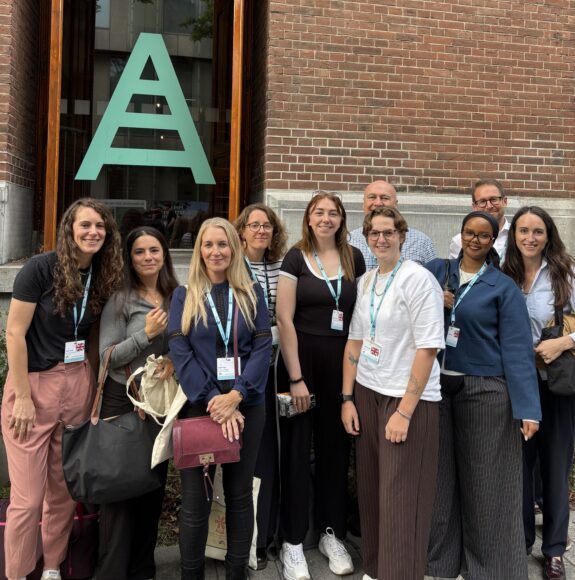
For the IPS Grow team, the journey to Rotterdam began in the best possible way and on the Eurostar. There was something really special about travelling directly from London to Rotterdam, with no airport queues, no complicated changes, and plenty of time to talk, reflect and build anticipation for the conference ahead.
Our group included 10 colleagues from IPS Grow, alongside representatives from the Office for Health Improvement and Disparities (OHID), the Department for Work and Pensions (DWP) and the Centre for Mental Health.
We were heading to the sixth IPS Europe Learning Community conference. I feel especially proud to have been involved in creating this movement, starting with the first conference in Reykjavík, Iceland, in 2021. Since then, the community has grown into an important space for sharing evidence, testing ideas and learning from the development of IPS in different countries and settings.
Rotterdam – Old and New
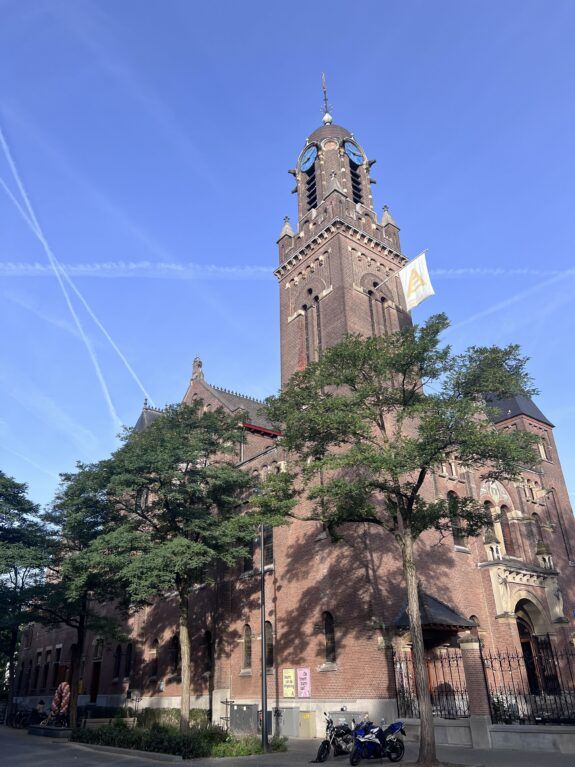
This year’s conference was held in Rotterdam, the Netherlands’ second-largest city. It is home to around 670,000 people in the municipality and more than 2.4 million across the wider metropolitan area. Rotterdam is also home to Europe’s largest port and has long been an important centre for international trade, logistics and innovation.
We also picked up an important local lesson as the country is officially called the Netherlands, not Holland. Holland refers specifically to two provinces, (North Holland and South Holland), rather than the country as a whole.
The conference programme was packed, so we saw relatively little of the city. Even so, Rotterdam made an impression. It’s a striking mix of old and new and much of the city centre was rebuilt after the Second World War, creating a distinctive blend of modern architecture, historic neighbourhoods, bold public spaces and one of Europe’s most recognisable skylines. In fact, one of the day 1 presentations drew a neat parallel that just as Rotterdam rose from the ashes of the war into a modern, vibrant city, IPS is emerging as a powerful approach to help people into good work.
A few of my IPS Grow colleagues managed to explore more of Rotterdam through early morning runs. Their reports were consistently positive about a cool, energetic and interesting city, with plenty more to discover.
IPS as a global movement
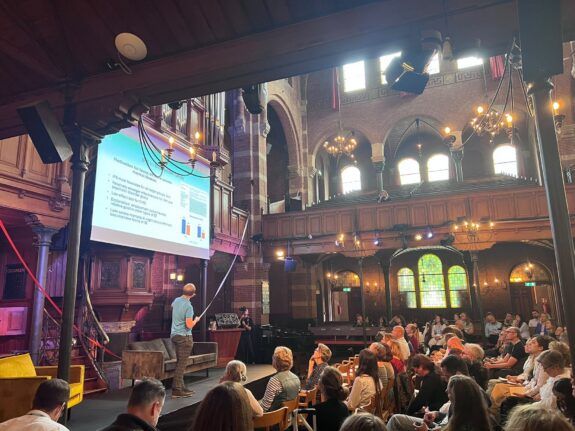
The conference speakers provided a rich overview of research, practice and policy developments from around the world. One of the most powerful reminders was that IPS is now a genuinely global offer.
IPS services are operating across 28 countries, including 20 countries in Europe, as well as Uganda, Peru, Mexico, Japan, South Korea, New Zealand, Australia and, of course, the USA. Each country is adapting IPS to its own health, employment and welfare systems, while retaining the principles that make the model distinctive and effective.
That raises an important question we explored at the conference on how far can we adapt IPS before we change what makes it IPS?
This is not just an abstract “academic” question. Rather a practical challenge for implementation, commissioning and service development. Adaptation is often necessary if IPS is to reach new groups and work effectively in different systems. At the same time, we need to protect the core ingredients that underpin the evidence such as integration with clinical or support teams, attention to individual preferences and strengths, rapid engagement with competitive employment, and in work support that responds to both the person and the workplace.
The conference made clear that IPS is both a defined evidence based model and a living global movement. Its future will depend on finding the right balance between fidelity and thoughtful adaptation.
Learning from Europe
There were many examples of exciting progress across Europe. Belgium is doing impressive work to expand IPS across three health systems including Flanders, the French speaking community and Brussels. Czechia is continuing to grow its IPS offer, while Norway and Denmark are developing important approaches to IPS for young people. The Netherlands is exploring how to support people who disengage from or drop out of an IPS service. This feels like a particularly valuable area of work. Helping someone into paid employment is important, but understanding how to reconnect with a person after an unsuccessful experience, a change in circumstances or a period of disengagement is equally significant.
The conference also highlighted trials and emerging work involving people with autism, obsessive compulsive disorder and learning disabilities. These developments show the continuing potential of IPS, while reminding us that new applications need to be tested carefully and delivered with the right expertise and support.
What it takes to scale
Colleagues from Finland shared useful insights from a literature review on the factors that can make or break IPS implementation. These included clear funding, leadership, legislation, training, managing staff turnover, political support and cultural issues. Drawing on 41 relevant research articles, the message was clear that scaling IPS is about much more than simply spreading something that works. It is an ongoing process of policy, influence and relationship building. As one presenter put it, “it takes two to tango”. In other words, successful scale up means hardwiring IPS into the system (such as into funding, policy, workforce development, leadership and everyday practice), rather than treating it as a short-term project or an add on.
Employers and good work
Sweden presented research on IPS and employer engagement, starting from a powerful principle that employment is a fundamental right, and good work matters. The World Health Organization’s guidance on mental health at work provides a helpful wider framework for the ecosystem needed to support good IPS practice (Guidelines on mental health at work).
Research from Lund University in Sweden on employer engagement reinforced the importance of the employment specialist role. Employers valued employment specialists who took time to understand their business needs and who could match a person’s strengths with what the employer was looking for.
The research also showed that many employers do not feel confident in understanding mental health conditions or knowing how best to support someone at work. They often do not know where to go for advice.
This is where a skilled ES can make a real difference, by building understanding, working through concerns and co‑creating practical solutions with the employer.
The discussion highlighted the Person-Environment-Occupation (PEO) model as a useful frame for in‑work support planning and workplace adjustments, looking at the person, their environment and the occupation together (PEO Model).
A simple approach when exploring each PEO dimension with the client to build their in work support plan:
- What’s working well? (for the person, the job, and the person’s environment)
- What’s difficult? (for the person, the job, and the person’s environment)
- What practical solutions could help?
- How can these be discussed and agreed together?
There was also a timely reminder that becoming a “worker” (understanding how to act, behave and manage a job), is as important as getting the job. Evidence continues to show the value of good in‑work support from the ES that goes beyond helping someone find paid work, by helping them settle, build confidence and sustain the job.
Supporting the IPS workforce
There was a strong focus on the employment specialists who deliver IPS every day. We heard about ways to engage, inspire and develop the workforce, while reducing the risk of stress and burnout.
A high-quality IPS service depends not only on systems, structures and training, but also on the confidence, relationships and wellbeing of the people doing the work. This was a welcome reminder that implementation is ultimately about people and great services are built by people who feel skilled, supported and able to do their best work.
Sharing England’s experience
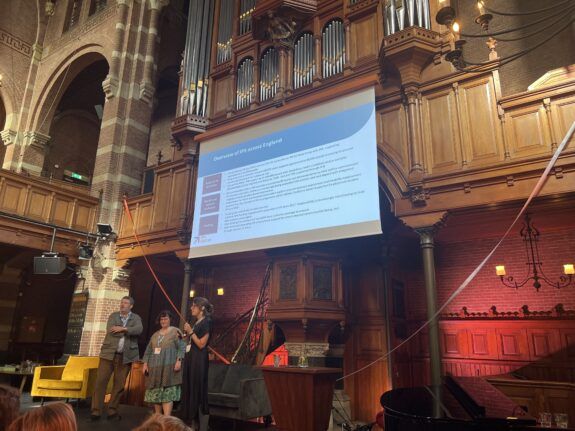
The IPS Grow team was pleased to contribute actively to the programme.
Amelia Willett from IPS Grow supported a workshop with DWP on integrating IPS into other settings. This created an opportunity to explore how IPS principles and practices can be embedded beyond traditional service boundaries, while maintaining the focus on individual choice, paid employment and effective partnership working.
I also helped facilitate a plenary session on research from around the world and developments in IPS across Europe. It was encouraging to hear the range of activity taking place, but also to reflect on the common challenges faced by countries at very different stages of implementation.
The England country pitch was beautifully led by my IPS Grow colleague Leila Reyburn. Julia Gault from DWP shared insights on Connect to Work, while Paul Anders from OHID contributed to the discussion about developments in England.
One of the strongest messages from the conference was that England’s approach to workforce development is genuinely groundbreaking. The investment in building skills, confidence, leadership and implementation capability has attracted considerable international interest.
It was inspiring to see colleagues from other countries responding so positively to what is being developed here. That recognition is welcome, but it also creates responsibility. We need to keep learning, evaluating and improving so that workforce development translates into better experiences and outcomes for people using IPS services.
AI as an opportunity and caution
Artificial intelligence was another important theme. There is growing interest in how AI might support IPS delivery by helping employment specialists organise information, identify useful resources, prepare for employer engagement and reduce administrative demands. Used well, these tools could help IPS teams spend more time on the human and relational parts of their role.
But there are also legitimate concerns. How do we augment the role of the employment specialist without weakening it? How do we make sure AI supports rather than replaces professional judgement? And how do we protect the trusting relationship needed between an employment specialist and the person they are supporting?
These questions matter because that relationship is not an optional extra in IPS. It is central to the work. People need to feel understood, respected and supported by someone who knows their ambitions, strengths and circumstances. AI may have a role in strengthening that work, but it should never undermine trust, choice, privacy or human connection. The conference created space to explore both the possibilities and the worries, and to recognise that responsible adoption will require careful testing, strong governance and the involvement of people who deliver and use IPS services.
Dinner, map directions and connections
The conference dinner offered a welcome chance to relax and continue conversations in a less formal setting. There was, however, one small complication as many of us had been given the wrong address.
What followed was an extended and slightly chaotic search for the correct location. Eventually, everyone arrived, settled in and enjoyed excellent food, good conversation and the chance to strengthen connections across the European IPS community. It was a useful reminder that conferences are not only about presentations and workshops. They are also about the informal conversations in between where comparing experiences, sharing practical solutions and discovering that colleagues in different countries are often wrestling with remarkably similar challenges.
There is still much to do
One statistic brought the scale of the challenge into sharp focus. Across the literature, around 60% of people with severe and enduring mental illness are not in employment, while only around 20% are working. The precise figures vary between studies and populations, but the overall message is clear that there remains a substantial employment gap.
IPS has made an important contribution to closing that gap, but there is still a long way to go.
The conference also reinforced why a recovery focused approach is essential for any IPS service, using the CHIME framework. Gaining a job supports all five core domains of personal recovery: Connectedness, Hope and optimism, Identity, Meaning in life, and Empowerment. Employment can contribute powerfully to each of these areas, which is why IPS matters far beyond job outcomes alone ((PDF) Conceptual framework for personal recovery in mental health: Systematic review and narrative synthesis).
Next stop: London
Rotterdam sent us home with new ideas, sharper questions and renewed energy. We left grateful to have been part of it and proud to belong to an international community focused on better employment outcomes for people with disabilities or disadvantages.
One absence was hard to miss in Rotterdam, and across much of the European evidence and practice shared, there was limited focus on race equity. In England, we’re on a journey to correct race inequalities for people using IPS services and to understand how better to serve and support the needs of everyone in the communities we work in. The 2027 conference in London gives us a chance to bring a spotlight to that work, share our learning so far and invite colleagues across Europe to learn with us.
The future of IPS depends on exactly this kind of openness, with sharing what works, being honest about what doesn’t, asking hard questions and learning from each other.
Rotterdam reminded us that IPS is a global movement. It also reminded us that IPS success will be measured in something very local and personal, such as whether more people get the paid work they want in the communities where they live.